
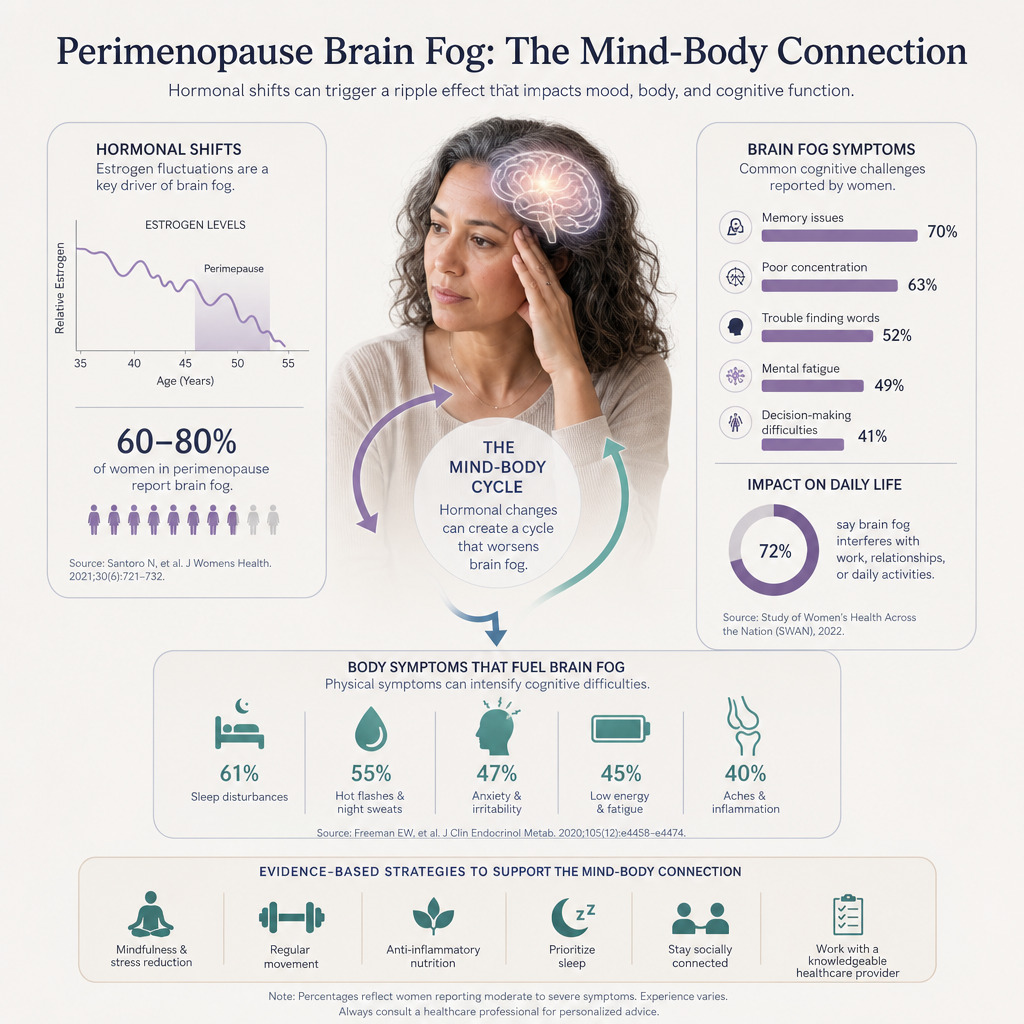
Brain Fog in Perimenopause: Causes, Symptoms, and What Actually Helps
| Perimenopause brain fog is real, documented, and temporary. Here’s the neuroscience behind why your memory feels like Swiss cheese — and what actually helps. |
You’re in the middle of a sentence. An important sentence. A sentence you were absolutely saying with confidence — and then it just… evaporates. The word you needed, the thought you were building, the name of the actress in that show — gone. You’re left gesturing vaguely at thin air while your brain spins its little buffering wheel.
If you’re somewhere between your early 40s and early 50s and this is becoming a familiar scene, welcome to perimenopause brain fog. Pull up a chair. We’d offer you coffee, but you’d probably forget why you walked into the kitchen to make it.
Here’s the most important thing to know before we dive in: you are not losing your mind, and you are almost certainly not developing dementia. What you are experiencing is a genuinely documented neurological transition driven by hormonal shifts — one that researchers have been studying with increasing urgency and seriousness. The fog is real. The science is real. And the good news? There are things that actually help.
What Perimenopause Brain Fog Really Feels Like
Let’s get specific, because validation requires specificity. Perimenopausal brain fog is not a vague sense of being “a little off.” For many women, it shows up as a surprisingly consistent cluster of complaints:
- Standing in front of the open refrigerator with absolutely no idea why you opened it
- Losing your train of thought mid-sentence — sometimes mid-word
- Reading the same paragraph three times and retaining nothing
- Forgetting names, appointments, and what you were just about to Google
- Taking noticeably longer to process new information at work
- That maddening “tip of the tongue” phenomenon where you can feel the word but cannot retrieve it
- Feeling like multitasking — something you used to crush — is now an Olympic feat you’re unprepared for
These symptoms are not figments of your imagination. A landmark longitudinal study, the Study of Women’s Health Across the Nation (SWAN), confirmed that processing speed, verbal memory, and learning capacity measurably dip during the perimenopausal transition, with the most significant changes appearing in the late perimenopause window. The encouraging footnote? For most women, cognitive function stabilizes and even recovers after menopause. This is a transition, not a destination.
| “The symptoms of perimenopause are largely neurological in nature… and affect multiple domains of cognitive function.”— Brinton et al.,Nature Reviews Endocrinology, “Perimenopause as a Neurological Transition State” |
Why Brain Fog Happens During Perimenopause
Here’s where we get to put on our neuroscience nerd hats, which — let’s be honest — is the best kind of hat. To understand why perimenopause affects your thinking, you first have to understand that estrogen isn’t just a reproductive hormone. It’s a full-on brain chemical. Your brain is absolutely loaded with estrogen receptors, and when estrogen levels begin their perimenopausal roller coaster — surging unpredictably before eventually declining — your neurons feel every single dip.
Estrogen as a Neuroprotective Hormone
Estrogen has been quietly functioning as your brain’s head of security for decades. It acts as a powerful antioxidant and anti-inflammatory agent within neural tissue, reducing oxidative stress that can damage neurons, supporting the production and maintenance of synaptic connections, and facilitating the release of acetylcholine — a key neurotransmitter involved in learning and memory. Estrogen also upregulates brain-derived neurotrophic factor (BDNF), essentially the brain’s own fertilizer, which supports the growth and survival of neurons.
When estrogen fluctuates erratically, as it does in perimenopause, this entire neuroprotective system is intermittently destabilized. The brain has to work harder just to maintain its baseline — and you feel that effort as cognitive fatigue, slowness, and that general sense that your mental gears need oiling.
How the Hippocampus Responds to Hormonal Fluctuation
Your hippocampus — the brain region most central to forming new memories and retrieving existing ones — is exceptionally dense with estrogen receptors. It is, in many ways, your most hormone-sensitive brain region. Research has consistently shown that estrogen supports hippocampal neurogenesis (the formation of new neurons) and the strength of synaptic connections needed to encode memories in the first place.
When estrogen levels fluctuate during perimenopause, hippocampal function can become inconsistent. Some days your recall is sharp; other days you’d struggle to remember what you had for breakfast. This variability is actually a hallmark of the perimenopausal cognitive experience — and it’s being driven by your hippocampus responding in real time to an unstable hormonal environment.
Glucose Metabolism and the Midlife Brain Energy Shift
This is perhaps the most fascinating — and underreported — piece of the puzzle. Estrogen plays a critical regulatory role in how your neurons produce energy. Specifically, it helps govern the uptake and metabolism of glucose in the brain, essentially ensuring your neurons have reliable fuel to fire properly.
When estrogen declines during perimenopause, research by Dr. Roberta Brinton and colleagues at the University of Southern California has shown that neuronal glucose transporters decrease, leading to measurable hypometabolism — a literal energy shortage in the brain. This is sometimes called the “brain energy crisis” of perimenopause. To compensate, the brain begins shifting toward alternative fuel sources, like ketone bodies, but this transition is imperfect and metabolically costly. Think of it like your brain suddenly having to run on backup generators — it keeps the lights on, but things run a little dimmer than usual.
| 💡 The “Dimmer Switch” Analogy Your brain on estrogen is like a house running on full-grid power — everything crisp and bright. Your brain during perimenopausal estrogen fluctuation is the same house running partial circuits: most rooms work fine, but some lights are flickering. The house hasn’t burned down. It just needs some electrical support. |
How Sleep Disruption Worsens Cognitive Symptoms
Let’s add insult to injury: perimenopause also disrupts sleep — thanks to night sweats, anxiety, and hormonal fluctuations — and sleep is when your brain does its most critical maintenance work. During deep sleep, the glymphatic system (your brain’s built-in waste-clearance network) flushes out metabolic byproducts, including amyloid proteins associated with cognitive decline. Miss the sleep, miss the cleanup.
When sleep is fragmented or shortened, this glymphatic clearance is dramatically reduced. Memory consolidation — the process of moving information from short-term to long-term storage — is also sleep-dependent. So if you’re lying awake at 3 a.m. with hot flashes, you’re not just exhausted the next day. You’re also cognitively compromised at a neurological level. The brain fog you feel after a terrible night is not weakness. It’s biochemistry.
Common Cognitive Symptoms in Perimenopause
Consider this your “you are not alone” data table. These are the cognitive symptoms most consistently reported by perimenopausal women in clinical studies and community surveys:
| Symptom | What It Feels Like | Likely Mechanism |
| Word retrieval difficulty | “It’s on the tip of my tongue…” (for 45 seconds) | Hippocampal and prefrontal disruption |
| Forgetfulness | Forgetting appointments, names, tasks mid-execution | Reduced hippocampal memory encoding |
| Losing objects | Keys, glasses, phone — all in mysterious locations | Reduced attentional encoding during daily tasks |
| Mid-sentence loss | Starting a thought and losing it before the period | Working memory and prefrontal cortex strain |
| Reading comprehension difficulty | Re-reading the same paragraph repeatedly | Reduced sustained attention and processing speed |
| Multitasking collapse | Feeling overwhelmed by simultaneous demands | Executive function and working memory load |
| “Tip of the tongue” syndrome | You know the word exists. You cannot produce it. | Verbal fluency networks under estrogen stress |
The peak of these symptoms tends to align with late perimenopause, when estrogen fluctuations are most extreme. Most women report noticeable improvement within one to two years after their final menstrual period — which is genuinely good news that is not repeated nearly enough.
Lifestyle Strategies That Support Cognitive Clarity
Let’s talk about what actually has evidence behind it. These aren’t “wellness” platitudes — these are physiologically grounded interventions with documented mechanisms in the brain. You don’t have to do all of them. Start with one. Build from there.
Aerobic Exercise and BDNF Support
If you could bottle any single intervention for perimenopausal brain fog, aerobic exercise would be it. Here’s why: physical activity — particularly sustained aerobic movement like brisk walking, jogging, cycling, or swimming — robustly increases BDNF, brain-derived neurotrophic factor, the very neurochemical that estrogen was helping produce.
BDNF promotes the growth of new neurons in the hippocampus, strengthens existing synaptic connections, and supports learning and memory. Research published in Neuroscience & Biobehavioral Reviews confirms that exercise increases BDNF through multiple pathways, including the PGC-1α–FNDC5–BDNF cascade. Even a 20-minute brisk walk produces measurable effects. Aim for 150 minutes of moderate aerobic activity per week — your hippocampus will thank you in ways your estrogen currently cannot.
Omega-3s and Brain Structure and Inflammation
The brain is approximately 60% fat by dry weight, and DHA (docosahexaenoic acid) — an omega-3 fatty acid — is its most critical structural component. DHA is essential for myelin integrity (the insulating sheath around your nerve fibers that governs signal speed), membrane fluidity of neurons, and the resolution of neuroinflammation.
During perimenopause, when the brain is already under metabolic stress, ensuring adequate DHA intake becomes especially important. Fatty fish (salmon, sardines, mackerel) are the richest food sources; algae-based omega-3 supplements are an excellent option if you don’t eat fish. Look for supplements providing at least 1,000 mg of combined EPA/DHA daily, and talk to your provider about what’s right for you.
Sleep Hygiene for Cognitive Repair
We established above that sleep is when your brain cleans house. Protecting your sleep quality during perimenopause is therefore a direct act of cognitive self-defense. Some evidence-supported strategies:
- Keep your room cool (around 65–68°F) to reduce the impact of night sweats on sleep continuity
- Maintain a consistent sleep schedule — your circadian rhythm is also hormonally regulated and benefits from anchoring
- Limit alcohol, which dramatically disrupts deep sleep architecture even in small amounts
- Consider magnesium glycinate in the evening — it supports GABA-mediated relaxation and is generally well-tolerated (check with your provider)
- Cognitive behavioral therapy for insomnia (CBTi) has the strongest long-term evidence of any sleep intervention and is available via apps like Sleepio
Stress Reduction and the Prefrontal Cortex
Chronic psychological stress floods the brain with cortisol, and cortisol is genuinely toxic to prefrontal cortex function at sustained high levels. Your prefrontal cortex governs planning, decision-making, working memory, and executive function — basically all the things that feel hardest when you’re in the fog. Stress makes the fog dramatically worse.
Mindfulness meditation, even in short doses of 10–15 minutes daily, has measurable effects on cortisol regulation and has been shown to support prefrontal cortex gray matter density over time. Apps like Headspace, Calm, or Insight Timer lower the barrier to entry significantly. Journaling is also a genuinely effective cognitive tool — using an external memory system (a written record of tasks, thoughts, ideas, and events) reduces working memory load and gives your brain a trustworthy second-in-command.
Social Connection and Cognitive Reserve
One of the most powerful (and underappreciated) buffers against cognitive decline is cognitive reserve — the brain’s accumulated resilience built through education, novelty, learning, and social engagement. Rich social connections, conversations that challenge you, learning new skills, and intellectual curiosity all contribute to a brain that is more resistant to disruption.
This isn’t license to sign up for sixteen things you don’t have energy for. It’s permission to treat your friendships, your book club, your ceramics class, or your language app as genuine brain health investments — because they are. Novelty and learning are BDNF triggers in their own right. And connection, for what it’s worth, also directly lowers cortisol.
Soft Solution Categories to Explore
Beyond the foundational lifestyle strategies, here are some additional avenues worth exploring with appropriate professional guidance:
- External memory systems: Don’t fight the fog alone — use it. Detailed to-do apps (Todoist, Notion, Apple Reminders), voice memos, a dedicated notebook, sticky notes, and calendar alerts are not signs of weakness. They are cognitive scaffolding while your brain navigates a transition.
- Adaptogens: Herbs like ashwagandha and rhodiola rosea have emerging evidence for supporting stress response and cognitive stamina, though research in perimenopausal populations specifically is still developing. Discuss with your provider before starting.
- Meditation apps: Headspace, Calm, and Insight Timer all offer guided practices specifically designed to support focus, sleep, and stress regulation.
- Support communities: Platforms like the Menopause Society, Reddit’s r/Perimenopause, and local support groups connect you with women who are living exactly what you’re living. The normalization effect is itself therapeutic.
- Hormone therapy discussion: For some women, menopausal hormone therapy (MHT) is a clinically appropriate option that addresses brain fog at the hormonal root. This is a nuanced, individualized conversation — but it belongs in your conversation with your OB/GYN or a menopause-trained provider.
Continue reading about natural remedies for perimenopause symptoms Best Supplements for Perimenopause
When Brain Fog Needs Medical Evaluation
Perimenopause brain fog is common, documented, and generally temporary. But certain cognitive changes fall outside its typical pattern and deserve professional evaluation — not to cause alarm, but to ensure you have complete, accurate information about your brain health. Speak with your doctor if you experience:
| ⚠️ When to Contact Your Provider • Rapid or progressive cognitive decline — changes that worsen noticeably month over month • Significant memory loss affecting daily function — missing important appointments, forgetting major recent events, repeated conversations with no recollection • Language difficulties — struggling to understand others, not just word-finding • Personality or behavioral changes — uncharacteristic responses, mood shifts beyond what perimenopause typically causes • Disorientation in familiar environments — getting lost somewhere you know well A neuropsychological evaluation provides a detailed baseline of your cognitive function and can definitively distinguish perimenopausal brain fog from other causes. Your primary care physician or OB/GYN can provide a referral. |
Knowing when to check in with a professional is wisdom, not catastrophizing. Most women who seek evaluation during perimenopause come away reassured — and better equipped with information about their own brain.
Related Topics to Explore Next
| 🔗See also:Perimenopause Anxiety: When Worry Feels Different Than It Used To |
Here’s what we want to leave you with: the brain fog you’re experiencing is not a character flaw, not a sign of aging poorly, and not a preview of cognitive decline. It is a documented, physiologically explicable response to one of the most significant hormonal transitions of your life. Your brain is not broken. It is adapting — loudly and imperfectly — to a new hormonal landscape.
Science is catching up. Researchers are studying perimenopausal brain health with more rigor and respect than ever before. And in the meantime, you have real tools: movement, nutrition, sleep, stress management, connection, and the profound relief of knowing that millions of other women are standing in open refrigerators right alongside you, equally baffled, equally okay.
Disclaimer
| Medical Disclaimer:This article is intended for general informational and educational purposes only and does not constitute medical advice, diagnosis, or treatment. The content is evidence-informed but should not replace consultation with a qualified healthcare provider. Perimenopause symptoms vary significantly between individuals. If you have concerns about your cognitive health, hormonal transition, or any other medical issue, please speak with your physician, gynecologist, or a menopause-certified specialist. Always consult a healthcare provider before beginning any new supplement, medication, or significant lifestyle change. |
Key References & Further Reading:
- Brinton, R.D. et al. “Perimenopause as a neurological transition state.” Nature Reviews Endocrinology, 2015.
- Maki, P.M. & Henderson, V.W. “Cognition and the menopause transition.” Menopause, 2016 (SWAN Study data).
- Givralli, J. et al. “The Interplay Between Physical Exercise, Nutritional Strategies, and BDNF in Promoting Cognitive Performance.” Aging and Disease, 2026.
- Jessen, N.A. et al. “The Glymphatic System — A Beginner’s Guide.” Neurochemical Research, 2015.
- MDPI. “Endogenous Hormones and Cognitive Decline in Women: Unveiling the Complex Interplay.” 2024.