
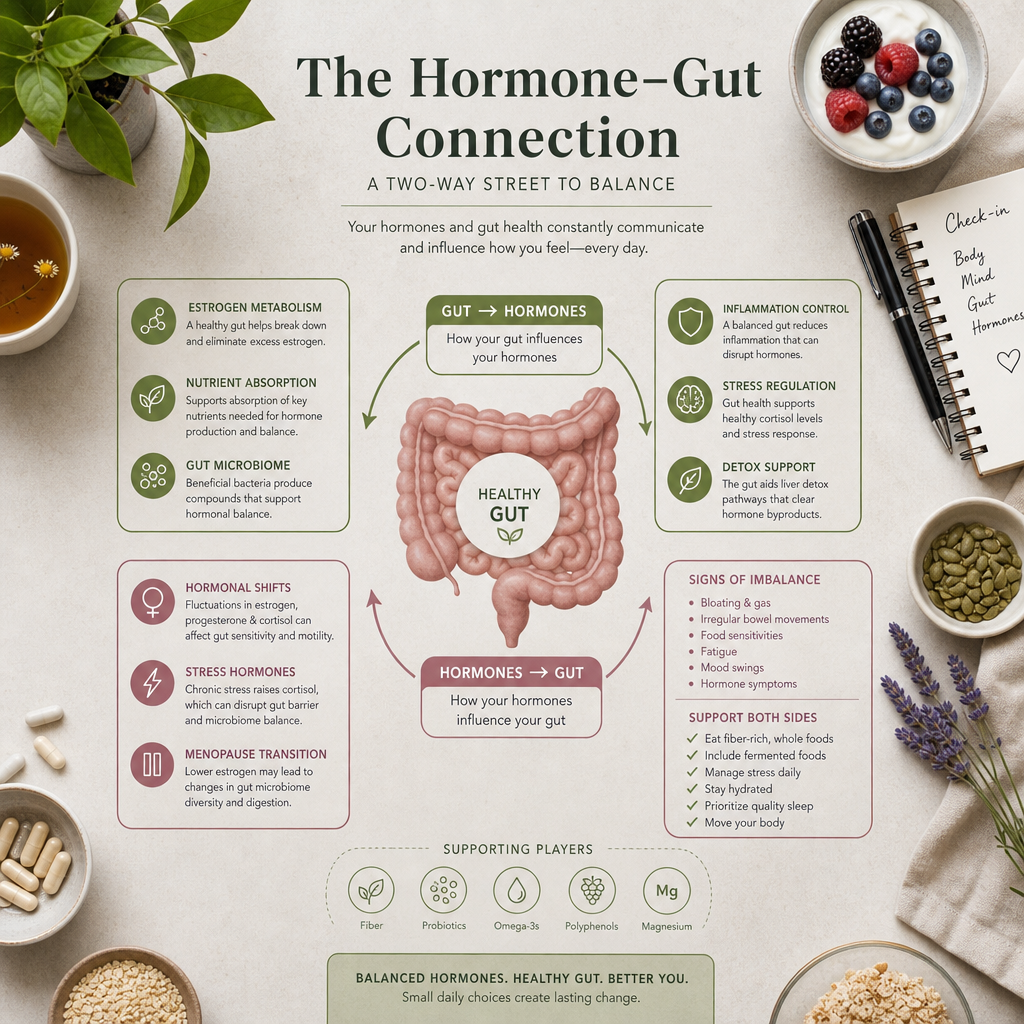
Digestive Changes During Perimenopause
Why Your Gut Is Acting Up (And What to Do About It)
| Bloated, constipated, suddenly sensitive to wine and cheese? Digestive changes during perimenopause are real, hormonal, and more common than you think — here’s why. |
Digestive changes during perimenopause are widespread — and overwhelmingly underreported. You’re not imagining it.
Suddenly Bloated, Constipated, and Gassy? Welcome to the Club
You haven’t changed what you eat. You’re drinking enough water. You’re doing all the things. And yet, somewhere in your early 40s — or maybe it crept in at 38 — your gut staged a quiet revolution. Pants that fit fine in the morning look borrowed by 7 p.m. The cheese board that used to be your love language now produces a sound effects reel you’d rather not share. And don’t get started on the constipation that appears from nowhere, or the mornings you spend convinced you’ve suddenly developed IBS.
Here’s the thing: you probably haven’t done anything wrong. What you have done is entered perimenopause — and your digestive system has very strong feelings about it.
A UK study presented at The Menopause Society found that a striking 94% of perimenopausal and menopausal women reported experiencing digestive health symptoms, with bloating (77%), constipation (54%), stomach pain (50%), and acid reflux (49%) being the most common. And yet the majority had never connected these symptoms to their hormones — and many who sought professional help found it inadequate.
This article is here to connect those dots for you, explain the actual physiology (it’s fascinating, truly), and give you a toolkit of things you can actually do about it.
Related Articles:
Why Perimenopause Causes Digestive Changes
Your gut isn’t just a passive tube that processes food. It’s a hormonally sensitive, neurologically active, microbially rich ecosystem — and it has a LOT of feelings about estrogen and progesterone. Here’s what’s happening at the biological level.
Estrogen, Progesterone, and Gut Motility
Your gastrointestinal tract is lined with estrogen and progesterone receptors — literally from your esophagus to your colon. These receptors influence everything from how quickly food moves through your gut (motility) to how sensitive your intestines are to gas and pressure (visceral sensitivity).
Progesterone relaxes smooth muscle throughout the body — which is why it’s so useful in pregnancy (relaxing the uterus), but less charming in your digestive tract, where smooth muscle contraction is what moves things along. When progesterone is high or erratic, as it so often is during perimenopause, gut motility can slow dramatically. Translation: food sits in your colon longer than it should, more water is absorbed from your stool, and you end up constipated. Fun!
Estrogen plays a different role: it helps regulate visceral sensitivity and gut transit time. When estrogen fluctuates and dips — which happens in an often unpredictable, rollercoaster fashion during perimenopause — your gut can become hypersensitive. The same amount of gas that never bothered you before now registers as actual pain or significant discomfort. This is the same mechanism that drives IBS, which is why so many perimenopausal women are (sometimes incorrectly) diagnosed with it around this time.
The Estrobolome and Hormone Recycling
Here’s where things get genuinely fascinating. A specific collection of gut bacteria — called the estrobolome — plays a central role in estrogen metabolism. These bacteria produce an enzyme called beta-glucuronidase, which deconjugates estrogens that have been processed by the liver and sent to the gut for elimination, allowing them to be reabsorbed into circulation.
Think of it like a recycling program for your hormones. When the estrobolome is diverse and thriving, estrogen recycling happens at a healthy rate. But when perimenopause disrupts gut microbial diversity — as research published in Nutrients (2026) confirms it does — the entire estrogen-metabolism system becomes dysregulated. Lower microbial diversity is associated with altered Firmicutes-to-Bacteroidetes ratios, increased inflammation markers, and worsened perimenopausal symptoms across the board.
In short: your gut bacteria help manage your hormones, and your hormones help shape your gut bacteria. When one wobbles, the other follows. It’s a feedback loop, and perimenopause can throw it well off balance.
Cortisol, Stress, and the Gut–Brain Axis
Perimenopause and stress are old friends — unfortunately. Sleep disruption, mood changes, and the general weight of midlife responsibilities all elevate cortisol, your primary stress hormone. Cortisol has a direct effect on the gut: it increases intestinal permeability (sometimes called “leaky gut”), meaning the tight junctions between gut cells loosen, allowing partially digested food particles and bacteria to cross the gut barrier and trigger immune responses. This drives bloating, inflammation, and heightened food reactivity.
The gut also communicates constantly with the brain via the vagus nerve — a two-way highway known as the gut–brain axis. Stress signals from the brain directly alter gut motility, secretion, and even the composition of your microbiome. The more stressed and sleep-deprived perimenopause makes you, the more your gut reflects it — and vice versa. It becomes a self-reinforcing loop that can be genuinely exhausting to navigate.
Histamine Intolerance and New Food Sensitivities
If you’ve suddenly developed what feels like an intolerance to wine, aged cheese, fermented foods, or even leftover chicken — welcome to the histamine conversation.
Estrogen and histamine have a bidirectional relationship: estrogen stimulates mast cells to release histamine, and histamine in turn stimulates the ovaries to produce more estrogen. Under stable hormonal conditions, this loop is manageable. But during perimenopause, when estrogen spikes erratically before eventually declining, this feedback system can spiral — flooding your body with histamine at the worst moments.
At the same time, estrogen suppresses diamine oxidase (DAO), the enzyme responsible for breaking down dietary histamine in the gut. With DAO capacity reduced, histamine from food — found abundantly in fermented foods, alcohol, aged cheeses, smoked fish, and leftovers — doesn’t get cleared efficiently. Symptoms overlap confusingly with hot flashes (flushing), allergies (sinus congestion), anxiety, and digestive distress. It’s not a new allergy. It’s hormonal physiology, and it’s more common than most clinicians recognize.
Common Digestive Symptoms in Perimenopause
These are the symptoms most frequently reported by women in perimenopause — all documented as hormonally-driven, not the result of poor eating habits:
| Symptom | What’s Driving It | When It Tends to Occur |
| Bloating (especially evening) | Slowed motility, visceral hypersensitivity, microbiome shifts | Often worse in luteal phase / second half of cycle |
| Constipation | Progesterone’s smooth-muscle-relaxing effect slowing transit | Mid-cycle to premenstrual; erratic in perimenopause |
| Loose stools / diarrhea | Prostaglandin surges around period; estrogen dips | Around menstruation; after estrogen drops |
| IBS-like flares | Visceral hypersensitivity, gut-brain axis dysregulation | Unpredictable; often stress-linked |
| Acid reflux / GERD worsening | Reduced motility; relaxed esophageal muscle tone | After meals; worse when lying down |
| New food intolerances (dairy, gluten, alcohol) | Gut permeability, microbiome shifts, histamine intolerance | Gradual onset, often surprises women |
| Nausea | Hormone fluctuations affecting gut signaling | Can mirror early pregnancy nausea; common in early perimenopause |
| Gas and flatulence | Slowed transit allows more fermentation by gut bacteria | Evening; after meals |
| ✅ Worth Knowing In a Menopause Society study, 82% of participants reported that their digestive symptoms either began or noticeably worsened at the start of perimenopause or menopause — yet only 33% had received a formal GI diagnosis. The symptoms are real. The hormonal link is real. You are not imagining things. |
Gut‑Supportive Strategies That Actually Help
None of these are magic bullets — but together, they form a genuinely evidence-informed approach to managing gut symptoms during hormonal transition. Think of it as tending your gut ecosystem during a particularly turbulent season.
Fiber-Rich, Phytoestrogen-Friendly Eating
Dietary fiber remains one of the most powerful tools for gut health — full stop. Aim for 25–35 grams per day, prioritizing a mix of soluble fiber (oats, flaxseed, legumes, apples) and insoluble fiber (leafy greens, whole grains, broccoli). Soluble fiber feeds beneficial gut bacteria and supports the estrobolome; insoluble fiber keeps transit time moving and reduces constipation.
Flaxseed deserves a particular mention here. It’s rich in lignans — a type of phytoestrogen that binds to estrogen receptors and can exert a mild modulatory effect on estrogen activity. Research suggests flaxseed may help with perimenopausal symptoms, particularly when consumed as ground flaxseed (2 tablespoons daily mixed into yogurt, oatmeal, or smoothies). Soy (edamame, tofu, tempeh) is another well-studied phytoestrogen source, with evidence from The Menopause Society supporting its modest benefit for symptom management. Neither replaces hormones, but both are food-first tools worth having in your repertoire.
Probiotic and Prebiotic Foods
Supporting your estrobolome means supporting your gut microbiome broadly.
Probiotic foods — such as yogurt, kefir, kimchi, sauerkraut, miso — introduce beneficial bacteria and can support microbial diversity. However, if you suspect histamine intolerance (flushing, headaches, sinus symptoms after eating fermented foods or alcohol), these same foods may temporarily worsen symptoms. In that case, consider a low-histamine trial period before reintroducing fermented foods gradually.
Prebiotic foods — including garlic, onions, leeks, asparagus, bananas, oats, apples, and legumes — feed beneficial gut bacteria and help support both microbial diversity and estrogen metabolism via the estrobolome. Additional sources include chicory root and Jerusalem artichokes (rich in inulin), dandelion greens, barley and rye, and resistant starch from slightly underripe bananas or cooked‑and‑cooled potatoes and rice. Because different fibers nourish different microbes, variety matters more than perfection.
Tolerance, however, is individual. Higher‑FODMAP foods like garlic, onions, and some legumes can worsen bloating for some women. If that’s the case, try gentler options like garlic‑infused oil, the green tops of spring onions, or reintroducing prebiotic foods gradually as your gut stabilizes.
| Note: What are “FODMAP” Foods |
| FODMAP: Fermentable Oligosaccharides (e.g., fructans in garlic, onions; GOS in legumes) Disaccharides (e.g., lactose in dairy) Monosaccharides (e.g., excess fructose in some fruits like apples) And Polyols (e.g., sorbitol and mannitol in certain fruits and sugar-free products) FODMAPs are a group of fermentable carbohydrates (found in foods like garlic, onions, legumes, and some fruits) that feed beneficial gut bacteria but can also produce gas and bloating in sensitive digestive systems. They’re not harmful — just sometimes poorly tolerated during periods of heightened gut sensitivity. |
Hydration and Motility Support
Adequate water intake is non-negotiable for gut motility. Aim for at least 8–10 cups of water daily, increasing with exercise or heat. Dehydration significantly worsens constipation, especially when progesterone is already slowing transit.
Gentle movement after meals — even a 10–15 minute walk — meaningfully improves gastric emptying and reduces the evening bloating that so many perimenopausal women describe. It doesn’t need to be vigorous; it just needs to happen. Movement also helps regulate cortisol, giving you a double benefit for the gut–brain axis.
Stress Management for the Gut–Brain Axis
This one sounds like advice you’ve heard a thousand times, but the gut–brain axis makes it a clinical reality rather than wellness fluff. Chronic elevated cortisol directly increases gut permeability, worsens visceral hypersensitivity, and shifts your microbiome in unfavorable directions.
Practices with genuine evidence for gut-brain regulation include: diaphragmatic breathing (activating the vagus nerve and parasympathetic nervous system), mindfulness-based stress reduction (MBSR), adequate and protected sleep, and reducing caffeine and alcohol — both of which elevate cortisol and worsen gut permeability. This isn’t about perfection. Even 10 minutes of intentional breathing daily moves the needle.
Identifying Personal Trigger Foods
Because perimenopause shifts your individual tolerance profile, a structured approach to identifying your personal triggers is often more useful than following a generic “gut health” diet. A 4–6 week elimination trial — removing the most common culprits (alcohol, caffeine, ultra-processed foods, dairy, gluten, high-histamine foods) and then reintroducing them systematically — gives you real data about your body rather than assumptions.
Keep a simple food-symptom diary noting what you ate, the time, and any symptoms in the following 2–4 hours. Patterns usually emerge within 2–3 weeks. This is most effective when guided by a registered dietitian who specializes in women’s hormonal health, so you don’t end up over-restricting and inadvertently narrowing your microbiome diversity.
Soft Solutions and Professional Support Options
Beyond diet, there are several avenues worth investigating with the appropriate professionals:
- Registered Dietitian (RD) specializing in perimenopause: An RD can guide elimination protocols, assess nutritional adequacy, and help you rebuild a diverse, gut-supportive diet without unnecessary restriction.
- GI Specialist or Gastroenterologist: If symptoms are significantly impacting your quality of life — especially if IBS, SIBO (small intestinal bacterial overgrowth), or inflammatory conditions are suspected — a gastroenterologist can provide targeted diagnostics and treatment.
- Comprehensive stool testing: Functional stool testing (such as GI-MAP or similar) can assess microbiome composition, beta-glucuronidase activity, gut inflammation markers, and pathogen presence. This is best interpreted alongside a trained clinician.
- Food sensitivity testing: IgG food sensitivity panels are commercially available, though evidence for their clinical utility is mixed. They may offer useful starting points but should not replace a proper elimination-reintroduction protocol.
- Probiotic supplementation: Strain-specific probiotics — particularly Lactobacillus and Bifidobacterium strains — show promise in supporting microbiome diversity during menopause. As noted in research published in Nutrients, strain-specific probiotics may modulate the estrogen–gut microbiome axis. Discuss with your provider before starting, particularly if you are immunocompromised.
- Hormone Replacement Therapy (HRT): If your perimenopausal symptoms are significantly impacting quality of life, HRT is worth a serious conversation with your OB-GYN or menopause specialist. Research suggests HRT users show microbiome profiles more similar to premenopausal women — meaning addressing the hormonal root may also benefit the gut downstream.
| 💡 Practical First Step Before booking every test and specialist, start with three simple changes for 4 weeks: ground flaxseed daily, a 15-minute walk after dinner, and a simple food-symptom journal. You’ll likely learn more from those three things than from any single test — and it gives your next specialist appointment much better data to work with. |
When Digestive Symptoms Need Medical Attention
While most perimenopausal gut symptoms are hormonal and benign, some require prompt medical evaluation. Do not dismiss or “wait and see” with the following:
| ⚠ Seek Medical Attention If You Experience: • Blood in your stool — whether bright red or dark/tarry (this always warrants evaluation) • Unexplained, unintentional weight loss of more than 5% of body weight over 6 months • Persistent diarrhea lasting more than 4 weeks that doesn’t respond to dietary changes • Severe or escalating abdominal pain — especially if localized, waking you at night, or accompanied by fever • Difficulty swallowing or a sensation of food getting stuck • New-onset symptoms after age 50 — these need evaluation to rule out colorectal cancer; the Mayo Clinic recommends that average-risk adults begin colonoscopy screening at age 45 • Symptoms consistent with inflammatory bowel disease (IBD): bloody diarrhea, cramping, urgency, rectal pain, or systemic symptoms like joint pain and fatigue alongside gut symptoms • Anemia or significant fatigue alongside gut symptoms — iron deficiency with GI symptoms warrants investigation for occult bleeding |
The message here is not to catastrophize normal perimenopausal gut symptoms — they are common and manageable. But your 40s and 50s are also the decade when colorectal cancer screening becomes important, and when IBD and celiac disease (which can present or worsen in perimenopause) should be ruled out for new or severe symptoms. Trust your instincts. If something feels significantly wrong, get it checked.
| Disclaimer: This article is intended for general educational and informational purposes only and does not constitute medical advice, diagnosis, or treatment. The information provided reflects current evidence-informed understanding and is not a substitute for consultation with a qualified healthcare provider. Always speak with your physician, registered dietitian, or gastroenterologist before making significant changes to your diet, starting supplements, or if you have concerns about your digestive health. Individual symptoms vary; what applies generally may not apply to your specific situation. |
Sources & Further Reading
- Cryan, J. F., O’Riordan, K. J., Cowan, C. S. M., Sandhu, K. V., Bastiaanssen, T. F. S., Boehme, M., Codagnone, M. G., Cussotto, S., Fulling, C., Golubeva, A. V., Guzzetta, K. E., Jaggar, M., Long-Smith, C. M., Lyte, J. M., Martin, J. A., Molinero-Perez, A., Moloney, G., Morelli, E., Morillas, E., … Dinan, T. G. (2019). The microbiota–gut–brain axis. Physiological Reviews, 99(4), 1877–2013. https://doi.org/10.1152/physrev.00018.2018
- Lim, M. J. S., Parlindungan, E., See, E., Gan, C. H., Yap, R., & Yong, G. J. M. (2026). Diet, the gut microbiome, and estrogen physiology: A review in menopausal health and interventions. Nutrients, 18(7), 1052. https://doi.org/10.3390/nu18071052
- Mayo Clinic. (n.d.). Colonoscopy. Retrieved June 27, 2026, from https://www.mayoclinic.org/tests-procedures/colonoscopy/about/pac-20393569
- Newson, L. (n.d.). IBS, perimenopause and hormones: What’s the link? Retrieved June 27, 2026, from https://www.drlouisenewson.co.uk/knowledge/ibs-perimenopause-and-hormones-whats-the-link
- The Menopause Society. (2025, October 10). Digestive health issues more common during perimenopause and menopause. https://menopause.org/press-releases/digestive-health-issues-more-common-during-perimenopause-and-menopause
- Hormone Health UK. (n.d.). Irritable bowel syndrome (IBS) and menopause: An overlooked connection. Retrieved June 27, 2026, from https://hormonehealth.co.uk/irritable-bowel-syndrome-ibs-and-menopause-an-overlooked-connection