
What Is Perimenopause?
A Warm, Real‑Talk Guide for Women in Their 30s and 40s
If you’ve landed here because your body suddenly feels like it’s running on a software update you did not approve, you’re not alone. So many women in their mid‑30s to late‑40s start noticing changes — sleep gets weird, cycles get unpredictable, moods feel like they’re on a roller coaster, and your favorite jeans suddenly have opinions.
And the wild part? Most of us were never taught what perimenopause actually is. We were told about puberty and menopause, but the long, messy, in‑between stage? Crickets.
So let’s fix that. Think of this as the conversation you’d have with your smartest, most supportive friend — the one who hands you a cup of tea, sits on the couch with you, and says, “Okay girl, here’s what’s really going on.”
Perimenopause – The Simple, Real‑Life Definition
Perimenopause is the transition phase leading up to menopause, when your hormones — especially estrogen and progesterone — start shifting in ways that can affect your cycle, mood, sleep, and overall well‑being.
It’s not a disease. It’s not something you “did wrong.” It’s a normal biological transition that every woman goes through, usually between ages 35 and 50.
The word itself literally means “around menopause.”
Menopause = when you’ve gone 12 months without a period.
Perimenopause = the years before that, when your hormones start fluctuating.
Think of it like the pre‑game show before the main event — except the pre‑game can last longer and be more dramatic than the event itself.
Why Does Perimenopause Happen?
Your ovaries gradually begin producing hormones in a less predictable rhythm. Instead of the steady monthly rise and fall you’ve had since your teens, your hormones start doing more of a zig‑zag pattern.
This can lead to:
- Irregular cycles
- Heavier or lighter periods
- Mood changes
- Sleep disruptions
- Hot flashes or night sweats
- Changes in libido
- Brain fog
- Skin and hair changes
If you want a deeper dive into symptoms, you can explore our symptoms guide.
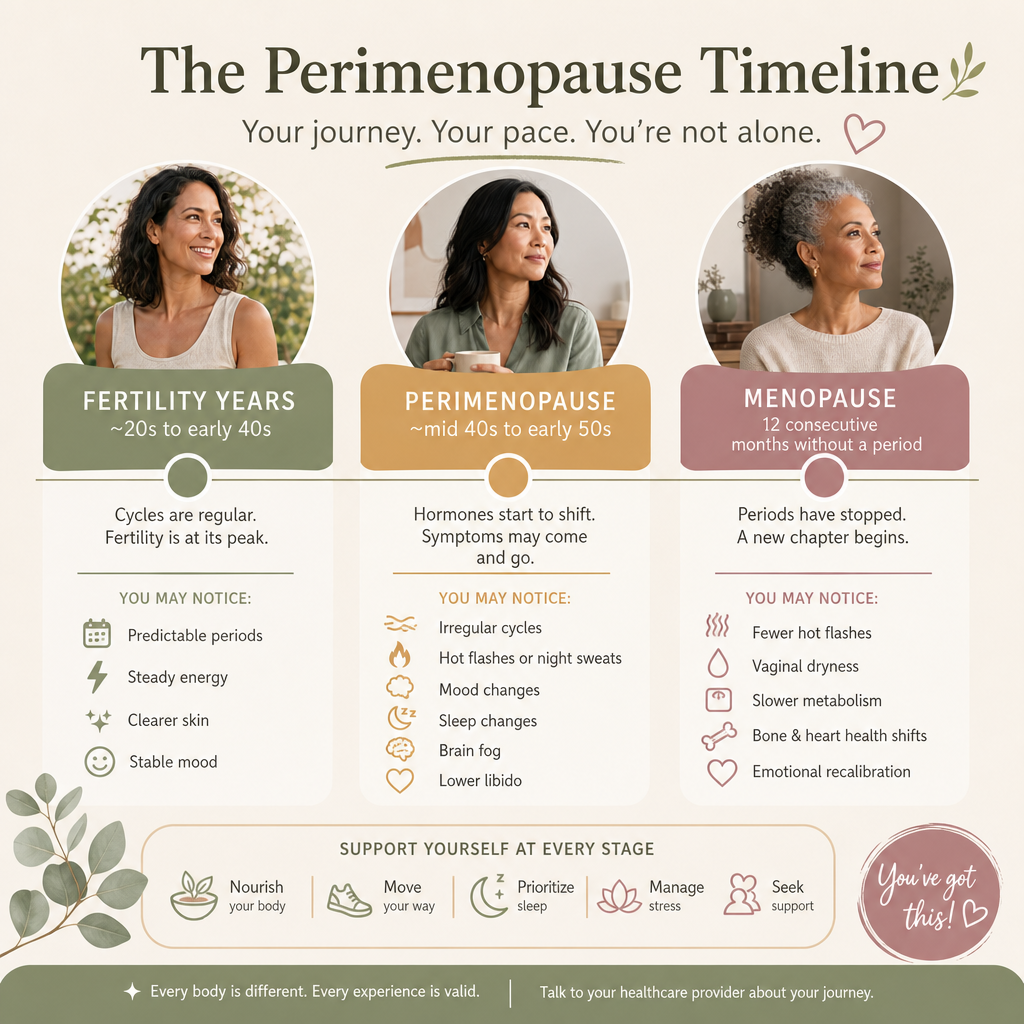
When Does Perimenopause Start? (The Timeline)
There’s no universal timeline — and that’s part of why it feels confusing. But here’s what research and medical consensus generally say:
Early Perimenopause (often mid‑30s to early 40s)
Hormone levels begin to fluctuate, but cycles may still look “normal.” You might notice subtle changes like:
- PMS that feels more intense
- Sleep that’s suddenly unreliable
- Anxiety or irritability that feels new
- Periods that come a few days early or late
Active Perimenopause (often early to mid‑40s)
Cycles become more irregular. Symptoms may become more noticeable. You may experience:
- Heavier or lighter periods
- Shorter or longer cycles
- Night sweats
- Mood swings
- Brain fog
- Fatigue
Related Topics to Explore Next – What is the Average Age When Perimenopause Begins?
Late Perimenopause (often mid‑40s to early 50s)
This is when cycles may skip months or become widely spaced. Hot flashes may increase. You may feel like your body is “winding down.”
Menopause (average age ~52)
You reach menopause when you’ve gone 12 months without a period.
Postmenopause
The stage after menopause, when hormone levels stabilize at their new baseline.
How Long Does Perimenopause Last?
Most women experience perimenopause for 4–8 years, but some have a shorter or longer transition. There’s no “right” length — your body has its own timeline.
Common Myths About Perimenopause
Let’s clear up some common misconceptions, because misinformation is everywhere.
1. “Perimenopause only happens to women in their late 40s.”
Nope. Many women start noticing changes in their mid‑30s. Early perimenopause is more common than most people realize.
2. “You’ll know you’re in perimenopause because your period stops.”
Actually, your period usually becomes irregular, not absent. Skipped periods typically happen in late perimenopause.
3. “Symptoms mean something is wrong.”
Not necessarily. Symptoms often reflect normal hormonal fluctuations. But if something feels off, it’s always okay to check in with a provider.
4. “You just have to suffer through it.”
Absolutely not. There are solutions — lifestyle, supportive strategies, and medical options — that many women find helpful.
5. “Perimenopause is the same for everyone.”
Every woman’s experience is unique. Some have mild symptoms; others feel like their body is running a whole new operating system.
What Medical Consensus Generally Says About Perimenopause
While research is ongoing, here’s what major medical organizations (like ACOG, NAMS, and the Mayo Clinic) generally agree on:
1. Perimenopause is a normal, natural transition.
It’s not a disease or a failure of your body.
2. Hormone fluctuations are the main driver of symptoms.
Estrogen and progesterone levels rise and fall unpredictably, which can affect multiple systems — mood, sleep, temperature regulation, and menstrual cycles.
3. Symptoms vary widely.
Some women barely notice changes; others experience significant shifts.
4. Lifestyle factors can influence how you feel.
Sleep, stress, nutrition, and movement can play a role in symptom intensity.
5. There are evidence‑supported options for symptom relief.
These may include lifestyle adjustments, mind‑body practices, and medical treatments. But what’s appropriate varies by individual, and decisions should be made with a healthcare provider.
For more on supportive strategies, explore our lifestyle articles.
What Does Perimenopause Feel Like? (The Real‑Life Version)
Here’s what women often describe — not as a diagnosis, but as lived experience:
- “I feel like I’m PMS-ing all month.”
- “My period is either a crime scene or a whisper.”
- “I’m tired but wired.”
- “My brain feels like it has too many tabs open.”
- “I’m sweating through my pajamas at 3 AM.”
- “I cry at dog food commercials now.”
If any of this sounds familiar, you’re not imagining it. Hormonal shifts can affect your nervous system, sleep cycles, and emotional regulation. See our section on Perimenopause Symptoms to learn more.
Why Perimenopause Is So Confusing (It’s Not You — It’s the System)
Most of us grew up with almost zero education about this stage of life. Add in cultural silence, outdated stereotypes, and the pressure to “keep it together,” and it’s no wonder women feel blindsided.
You’re not dramatic.
You’re not “losing it.”
You’re not alone.
You’re going through a major hormonal transition — and you deserve information, support, and community.
When Should You Consider Talking to a Healthcare Provider?
You don’t need a crisis to reach out. Many women find it helpful to talk with a provider when they notice changes that affect their daily life.
Here are general situations where a check‑in may be helpful:
- Periods that are extremely heavy or last longer than usual
- Bleeding between periods
- Cycles that suddenly become very short or very long
- Symptoms that interfere with sleep, work, or relationships
- New or worsening anxiety or mood changes
- Pain that feels unusual for your body
- Concerns about fertility
- Questions about treatment options
A provider can help rule out other conditions, explain what’s typical, and discuss supportive strategies.
How to Support Yourself During Perimenopause
This isn’t about “fixing” your body — it’s about supporting it through a transition.
Here are gentle, research‑informed approaches many women find helpful:
Prioritize sleep (even if it feels impossible).
Sleep changes are common, and small habits can make a difference.
Nourish your body consistently.
Blood sugar swings can amplify symptoms like irritability and fatigue.
Move your body in ways that feel good.
Strength training, walking, yoga — all can support mood, sleep, and energy.
Build a stress‑support toolkit.
Meditation, breathwork, therapy, journaling — whatever helps your nervous system feel safe.
Stay connected.
Isolation makes everything harder. Community makes everything easier.
For more supportive ideas, explore our solutions and lifestyle articles.
The Emotional Side of Perimenopause (The Part No One Talks About Enough)
Perimenopause isn’t just physical. It can stir up big feelings — identity shifts, life transitions, relationship changes, career pressures, caregiving roles, and the sense that your body is rewriting its own rules.
You might feel:
- More sensitive
- More reflective
- More easily overwhelmed
- More aware of what you want (and don’t want)
This stage can be challenging, but it can also be clarifying. Many women describe it as a time of reclaiming themselves — their boundaries, their energy, their priorities.
You’re not “too much.”
You’re evolving.
What Helps Women Feel More in Control?
Not medical advice — just common themes women share:
- Understanding what’s happening in their body
- Tracking symptoms to notice patterns
- Talking openly with friends or partners
- Learning about hormonal changes
- Exploring supportive lifestyle habits
- Working with a provider when needed
Knowledge is power. And you deserve to feel informed, not blindsided.
A Quick Comparison: Perimenopause vs. PMS vs. Menopause
| Stage | What’s Happening | Common Signs |
| PMS | Normal monthly hormone shifts | Mood changes, bloating, breast tenderness |
| Perimenopause | Hormones fluctuate unpredictably | Irregular cycles, sleep changes, hot flashes, mood shifts |
| Menopause | 12 months without a period | Hot flashes may continue, cycles stop |
| Postmenopause | After menopause | Hormones stabilize at a new baseline |
You’re Not Alone — And You’re Not “Crazy”
If you’ve been feeling confused, overwhelmed, or like your body is suddenly doing its own thing, please hear this:
You are not imagining it.
You are not failing.
You are not alone.
Perimenopause is a major hormonal transition — and you deserve support, information, and compassion every step of the way.
Where to Go Next
If you want to keep learning, here are helpful places to explore:
And if you’re feeling overwhelmed, take a breath. You’re doing great. Your body isn’t betraying you — it’s transitioning, and you’re allowed to take your time learning what that means.
Medical disclaimer: This article is for general education only. It isn’t medical advice, diagnosis, or treatment. If you have questions about your health, please talk with a qualified healthcare provider.